
Unified insurance and banking into a single mobile platform
Prioritized high-frequency actions like claims and agent contact
Unified insurance and banking into a single mobile platform
Prioritized high-frequency actions like claims and agent contact
Summary:
As VP of Product Design at Taylor Digital, I led product and experience strategy for State Farm's Pocket Agent platform, a national mobile application supporting millions of policyholders across insurance and banking services.
The initiative focused on modernizing the customer experience, increasing engagement, and improving retention by transforming fragmented mobile interactions into a cohesive, user-centered platform aligned with evolving customer expectations.

The initiative focused on modernizing the customer experience, increasing engagement, and improving retention by transforming fragmented mobile interactions into a cohesive, user-centered platform aligned with evolving customer expectations.
Key Research Impact:
Key Decisions:

My Role:
I led a 15-person product design and research organization, overseeing product direction, experience strategy, and delivery performance across State Farm’s mobile platform initiatives.
My role combined executive-level strategy with hands-on leadership, aligning cross-functional teams, influencing senior stakeholders, and ensuring high-quality delivery across a complex, regulated environment.
I established design leadership practices, introduced structured research and analytics frameworks, and guided teams in translating behavioral insights into scalable product improvements.
Key contributions included:
Program Context:
This work extended beyond a mobile redesign. It required aligning product, design, engineering, and business stakeholders across a multi-million-dollar digital portfolio to improve onboarding, engagement, and long-term customer relationships.
The program balanced strategic platform evolution with iterative delivery, leveraging behavioral analytics, experimentation, and continuous feedback to drive measurable business outcomes.
Challenge:
State Farm's existing mobile experience had grown organically, resulting in fragmented navigation, inconsistent workflows, and limited alignment with how customers actually managed their policies and financial services.
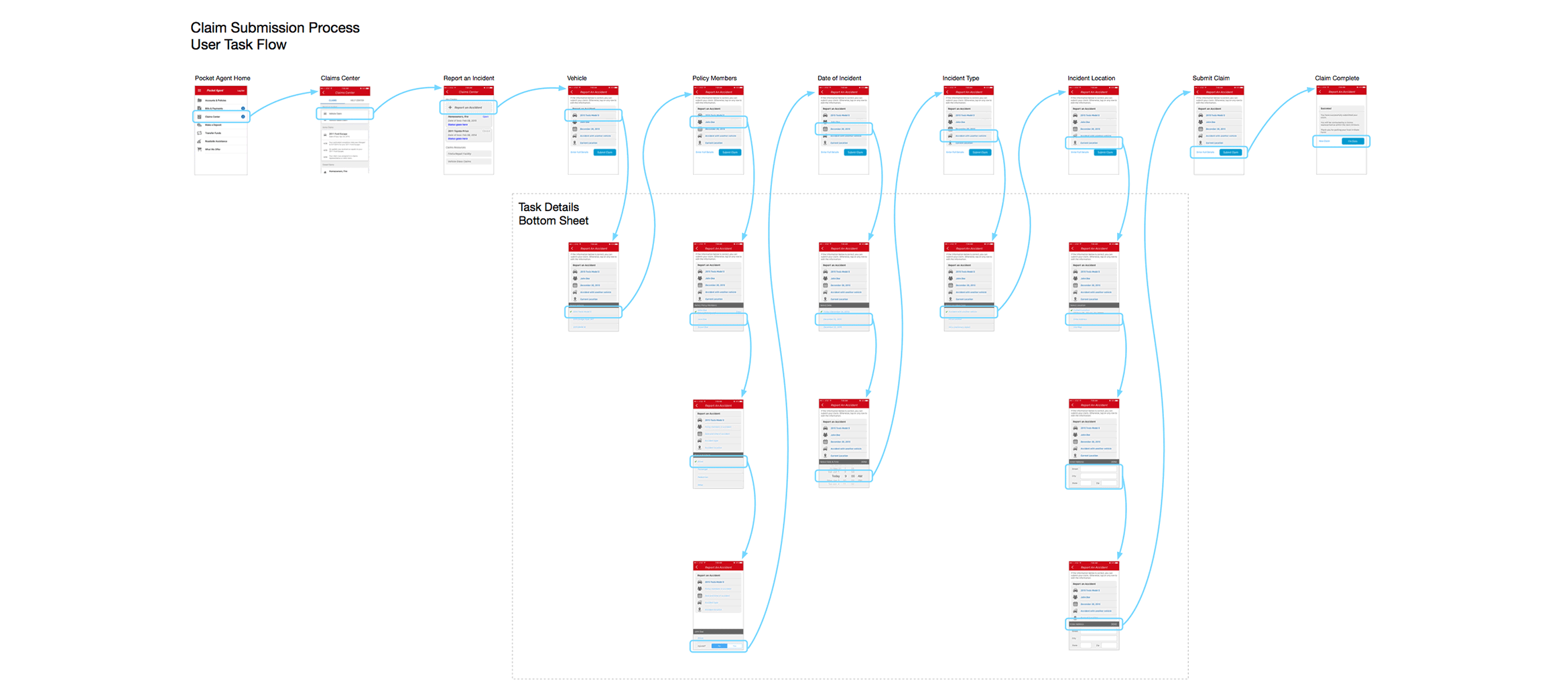
Key customer journeys, including claims, payments, and policy access, required unnecessary effort, reducing engagement and limiting feature adoption.
At the same time, the organization needed to modernize its digital capabilities while maintaining strict regulatory compliance and aligning across multiple internal stakeholders with competing priorities.
The challenge was to redefine the mobile experience as a strategic platform, simplifying interactions, improving usability, and driving measurable improvements in engagement, retention, and customer satisfaction.
The redesigned Pocket Agent platform transformed fragmented insurance and banking interactions into a single, user-centered mobile experience built around the actions customers needed most.
Strategy & Execution:
The platform redesign followed a data-informed, user-centered approach that connected research, analytics, and delivery.
Customer insights were translated into prioritized product opportunities, which were validated through iterative design, prototyping, and testing.
Cross-functional collaboration ensured alignment between business objectives, technical feasibility, and regulatory requirements, enabling coordinated execution across teams.
Design critique, feedback loops, and continuous iteration were embedded into the delivery process, improving both product quality and team performance.

The platform redesign created a scalable, customer-centered mobile experience that improved access to claims, payments, agent contact, roadside assistance, and insurance documentation.
Experience Transformation:
The redesigned Pocket Agent platform introduced a simplified, intuitive experience focused on the most critical customer needs:
These improvements created a more cohesive and accessible experience, supporting both new and existing customers across a wide range of use cases.
By prioritizing claims, payments, agent contact, roadside assistance, and insurance card access, the platform made critical tasks faster, clearer, and easier to complete during high-stress moments.

Operating Model & Delivery:
Delivery followed an integrated cross-functional model aligning product, design, engineering, and business stakeholders.
Behavioral analytics, user research, and product performance metrics were incorporated throughout the lifecycle, enabling continuous optimization and informed decision-making.
This approach ensured that product improvements were both strategically aligned and operationally feasible at scale.
Impact & Performance:
The platform transformation delivered measurable improvements across engagement, satisfaction, and business performance:
Continuous Improvement:
Following launch, I established ongoing analytics review cycles and feedback loops to guide continued optimization.
Product performance, user behavior, and stakeholder input informed roadmap evolution, ensuring sustained improvements in engagement, efficiency, and customer satisfaction over time.
Strategic Impact:
This initiative demonstrated how strategic product leadership, behavioral insights, and disciplined execution can transform a complex, regulated platform into a scalable, customer-centered experience that advances both user satisfaction and business performance.
By aligning product strategy, behavioral insights, and disciplined execution, the Pocket Agent transformation advanced both customer satisfaction and measurable business performance.
